The Rip Chords
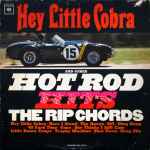
The Rip Chords were an early-1960s American vocal group, originally known as the Opposites, composed of Ernie Bringas and Phil Stewart. The group eventually expanded into four primary voices, adding Columbia producer Terry Melcher and co-producer Bruce Johnston (best known as a member of the Beach Boys). This group came to be associated with the hot-rod and surf genres of that day, although their first single ("Here I Stand") did not reflect those styles. They recorded for Columbia Records in Hollywood from 1962 to 1965. The group placed five singles on the Billboard Hot 100. They are best known for their number-four single: "Hey Little Cobra". Bringas and Stewart became acquainted during the mid-1950s as students at Inglewood High School (about ten miles south of Hollywood). They discovered some complementary musical talents and struck up a friendship. Encouraged by their singing compatibility, they were determined to secure a recording contract. They eventually came to the attention of Arwin Records/Daywin Music in 1962. Actress-singer Doris Day and her husband, film producer Marty Melcher, owned Arwin Records and Daywin Music. Their son, Terry Melcher, had just been hired by Columbia Records as an A&R (artist and repertoire) producer. Arwin Records vice-president Bob Crystal saw potential in Bringas and Stewart's voices, and quickly arranged for an audition at Columbia Records. Following the audition, Terry Melcher signed Bringas and Stewart to a recording contract at Columbia. Their moniker, the Opposites, seemed apropos at the time because Bringas was studying for the ministry and Stewart was a private detective. But shortly before their first release, the name was changed to the Rip Chords. The change was prompted by concerns that the Opposites could falsely imply a positive versus negative image of the two friends. According to Melcher, "Actually, I gave them the name and it was just a play on words. It had nothing to do with the TV show Ripcord (spelled without the h)." The Rip Chords were a vocal group. They were not a band (no musical instruments, although Stewart played limited guitar). Accordingly, Bringas and Stewart needed to be backed instrumentally by studio musicians. These musicians, including guitarist Glen Campbell, drummer Hal Blaine, and bassist Ray Pohlman, and other prominent instrumentalists, were known as the Wrecking Crew. Terry Melcher produced the Rip Chords' first release, "Here I Stand", a remake of the Wade Flemons version. Recorded on December 17, 1962, it peaked at No. 51 on the Billboard Hot 100 in early 1963. Bringas and Stewart were the only singers on the first release. Bringas sang the lead, the falsetto, and also joined Stewart on the background vocals. Bringas and Stewart agreed that "Glen Campbell...gave the song a great lift with his lead guitar. Recent remix attempts have watered down his contribution, but on the original release, the imprint of his lead guitar is indelible." The group's second single, again produced by Melcher, was "Gone", recorded April 26, 1963. Bringas sang the lead and the falsetto, with Bringas and Stewart doing layered background vocals. Bruce Johnston (a friend of Melcher) added an interjecting falsetto, and Blossoms member Gracia Nitzche performed the spoken word intro. Although the song penetrated the Billboard Hot 100, it did not fare as well as the previous hit, "Here I Stand", but did well in certain markets such as San Antonio, Texas, where it climbed to number two on KTSA's top 55 survey. Following the release of "Gone", a problem arose for the Rip Chords. Bringas had just graduated from California State University at Long Beach and was planning to do graduate work at United Theological Seminary in Dayton, Ohio, where he eventually earned his Master of Divinity degree. His educational responsibilities would not allow time for the touring aspect of a recording group. Due to his ministerial studies, Bringas was unable to get back to Hollywood for the next recording session. This left Stewart momentarily without a singing partner. Melcher and co-producer Johnston stepped in vocally to fill the void created by Bringas' brief absence; Johnston had already sung with Bringas and Stewart on their second single "Gone". Melcher and Johnston would prove to be a significant addition as the Rip Chords prepared to record and release their third single. The Rip Chords' third single was the hit "Hey Little Cobra", vocally layered by Melcher and Johnston, recorded on October 15, 1963. Melcher sang the lead vocal. He and Johnston did the background vocals. The song peaked at No. 4 on the Billboard Hot 100 in February 1964. It reached #3 on the New Zealand lever hit parade charts Initially, when the "Cobra" single was released, Johnston and Melcher did not receive any credit for their vocal participation. However, Melcher did receive credit as the producer. Following the “Cobra” single and album, both Melcher and Johnston were credited as the two producers on all Rip Chords’ music thereafter, but their vocal contributions remained uncredited. Following the "Hey Little Cobra" single, Bringas, having missed the previous recording session, was able to rejoin the group. However, based on the success of the ″Cobra″ single, the original Rip Chords (Bringas and Stewart) would now expand into four primary voices, adding Melcher and Johnston. Although Bringas was back in the studio to record, he remained unavailable for touring because of his educational commitment. Therefore, as a practicality, two young men (Rich Rotkin and Arnie Marcus) were brought on board to tour with Stewart as the Rip Chords until the group disbanded in 1965. Thus, Stewart, Rotkin, and Marcus became the official touring version of the Rip Chords. However, Rotkin and Marcus were never vocally involved in any Rip Chords' recordings. Columbia Records never made a distinction between the recording Rip Chords and the touring Rip Chords. On the contrary, it was only the touring Rip Chords that were promoted in all of the publicity campaigns. Their names and pictures appeared in ads, interviews, photoshoots, magazines, album covers, and so forth. Additionally, the touring ensemble was invited to appear on Dick Clark's American Bandstand and toured on Clark's 1964 Caravan of Stars (which included the Supremes and other notables). They also performed in the 1965 Hollywood film, A Swingin' Summer, with Raquel Welch. Therefore, very few of the music industry and the public at large realized that the touring Rip Chords and the recording Rip Chords—with the exception of Stewart—were not the same people. The Rip Chords' first album (released in early 1964) was Hey Little Cobra and Other Hot Rod Hits, which peaked at No. 56 on the national charts. The album featured balanced contributions from Bringas, Stewart, Melcher, and Johnston. Of the 11 vocals, Melcher sang lead on five, Bringas sang lead on five and Stewart sang lead on one. An instrumental by the Wrecking Crew filled out the album. Its cover listed Bringas and Stewart as vocalists, omitting Melcher and Johnston, and incorrectly including Rotkin and Marcus. The group's fourth single was "Three Window Coupe", released in April 1964 with Melcher singing lead, peaking at No. 28 on the national charts. Although all four singers contributed to the recording, the Melcher-Johnston sound predominated. Johnston and Melcher's experience and vocals were a major factor in the California Sound of the Rip Chords' music. The Three Window Coupe album (CS 9016 or CL 2216), released three weeks after the "Three Window Coupe" single, added another 11 vocals: Melcher sang lead on six of them, Bringas and Stewart sang lead on four, and Melcher and Bringas shared the lead on one song ("My Big Gun Board"). Like Hey Little Cobra and other Hot Rod Hits, its liner notes erroneously listed Rotkin and Marcus as vocalists and Melcher and Johnston's vocal involvement was not mentioned. The 2006 Summer U.S.A.!
Discografía en vinilo
Ordenada por relevancia (lo más escuchado primero).

En la onda de The Rip Chords
Otros artistas afines, con vinilo.