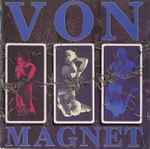
Von Magnet
Von Magnet is a theatre music band that originated in the post-industrial musical current of the 1980s. Founded in 1985 in London, the group gathered around Flore Magnet (stage direction, actions, vocals) and Phil Von (composition, feet percussion, vocals) initiating a style of their own which they named "Electroflamenco". Becoming rapidly well known in the underground because of their new approach to electronic music, firstly by incorporating the bases of flamenco (rhythms, dances and melodies) then later adding influences of Middle Eastern music. This electronic ethnic mix, often referred to as "expressionist" or even tribal music, features also references to contemporary and cinematographic soundscapes, (Andreï Tarkovski, John Cassavetes, Carlos Saura, Amos Gitai, etc.). Their compositions, either instrumental or vocal melodramas, poetic, lyrical, cabaret crooning are sung or spoken in different languages; English, Spanish, French, and also in Arabic, German, Turkish or Russian. Since 1985, even before the "Computer music" era, they experimented within the likes of the post-industrial musical movement (Greater Than One, Cabaret Voltaire, SPK, Coil...) using intensive sound collage and sampling techniques. This work will give birth to their motto: "Sample us as we have already sampled you". Although strongly focused around the music component, the peculiarity of Von Magnet is to endeavour the recurrent relationship between theatrical actions, dance as well as visual or performance arts, resulting in the creation of "staged" concerts. These multidisciplinary performances bring together musicians, actors, dancers, sculptors, video artists... destabilizing the codes or the staging conventions, the musicians become acting characters whereas the dancers/actors are bound to participate in live sound creation. Fiona Kelso joined them in a brief tour in 1989. After a collaboration with Robert Rental (The Normal) with whom they prepared their first demo tapes, Von Magnet, helped by Hugh Griffiths at the Remaximum studios, composed their first auto-produced E.P : "I". The record, firstly confidential, was soon distributed within Europe and featured in the charts of the independent music dance clubs. Coming from the world of theatre (Flore Magnet, Samia Doukali), visual arts (Laurence Abraham, Erik Yaeger) or music (Stocha, Phil Von), the different individuals forming the group invented a style of performance which combined all of those disciplines. In parallel, they were initiated to flamenco rhythms (palmas, zapateados, palos) by dancer Nuria Garcia and guitarist Mick Jingle (members of the London Peña Flamenca) who both contributed to the first showings and tours. Von Magnet met with music wizard Phil Erb (keyboard player of the group Psychic TV) as well as producer Ken Thomas (Psychic TV, Test Dept, Sigur Rós, Dave Gahan, The Sugarcubes, Moby, Yann Tiersen, Current 93...), with whom they achieved their album El Sexo Sur-Realista, their first Electroflamenco manifesto inspired from Federico Garcia Lorca and Salvador Dalí, iconic flamenco artists Camarón de la Isla, Lole y Manuel, Enrique Morente as well as from early electronic acts such as Suicide, Deutsch Amerikanische Freundschaft, The Residents...). This performance, outlined in the London underground club scenes, then presented in diverse theatre festivals (Institute of Contemporary Arts, LIFT, National Review of Live Art...) went on to tour throughout Europe with the help of the Dutch agency NL Centrum. The scenography of the performance is set around a saw dust arena (a reference to bullfighting) surrounded by television screens and two opposite stages. Metal costumes hung from the ceiling, objects made out of wire (creations of Andalusian sculptor artist Manuel Olarte), physical actions, slide projections, flamenco dance and guitar, saxophone (Stocha), singing and electronic sequences are fused together to form this first interdisciplinary piece. Von Magnet left London to lead a new nomadic life following the path of different residencies and tours in Europe. They settled for a while in Barcelona, then Brittany, Paris, Amsterdam and Lille. The Rencontres Transmusicales Festival commissioned them for the creation of major multidisciplinary performance. Computador was born. Partially invented inside an abandoned slaughterhouse in Badalona (Catalonia) then created in a church in Rennes, the show was later on modified and re-adapted inside old disused factories or odd alternative spaces (hospital, warehouses, etc.). With that "off" or non-stage production, the band became a real collective, close to street theatre or circus companies, sometimes compared to La Fura Dels Baus.[citation needed] With stages on wheels, moving objects and giant sculptures (Manuel Olarte), ingenious MIDI triggering, Pani projections (designed by Thierry Noyer), futuristic characters hanging in the air, acrobatics, contemporary and flamenco dance, water, fire and welding. Computador talked about mutations, human (physical or psychological) or material (scenographic), pushing the limits which can define a performance piece, questioning the place, voyeurism and comfort of an audience as well as constantly transforming the space and actions. The troupe expanded with the encounter of Spanish performer & actress Rosa Sanchez, Austrian performer Franz F. Feigl and French musician TNO. More artists arrived to collaborate on different presentations of this big project (Mariana Bouhsira, Gregory Ryan, William Petit, Rob Verdegaal, Patricia Ruyters, John Wagland, Kate Tierney, Ken Thomas, Mick Jingle, et al.). The album Computador portrayed the soundtrack studio version of the show as a musical drama. It was recorded by Norscq (aka JLM from the cult band The Grief) and again produced in London by Ken Thomas for the French record label Danceteria. To access a different network of smaller venues on a broader scale, Flore Magnet, Laurence Abraham, Rosa Sanchez, Stocha, Phil Von & Erik Yaeger, decided to condense their favourite themes. Coming back to a new concert-performance formula, this time more accessible, the show "Flamenco mutants" took place in rock venues, discothèques or art galleries. The guitarist Sigmoon, aka Pierre Vildard, joined the venture. The last chapter of their electroflamenco trilogy, El Grito, produced by Norscq for Danceteria, proposed an opus of maturity which summed up their experience of industrial gypsy life. After paying tribute to Salvador Dalí (El Sexo Sur-Realista) & Andreï Tarkovski (Computador), this time it is Luis Buñuel & Jean Cocteau who are honoured in El Grito. New guest musicians excelled on that record, Simon Lee (cajon), Micha S. Zanx (electric guitars) and Richard Cuvillier, trumpet player, composer and sound engineer who also played on the record Mezclador and live for De L'Aimant. Invited by choreographer Jan Linkens to create the ballet Nuevas Cruzes at the Komische Oper Berlin, Von Magnet mutated once again, proposing a different musical approach. More acoustic or even "electro-rock", they brought a specific selection of songs onto the opera stage in the middle of the classical ballet dancers. The percussionist Jérome Soudan aka Mimetic (Tétines Noires, Art Zoyd) became the first drummer of Von Magnet. Countertenor singer François Testory (Lindsay Kemp company), whom they met in London for El Sexo Sur-realista, was invited especially for the occasion. Nuevas Cruzes was presented in Berlin for three years, then toured throughout Europe. It is that encounter with the world of German Ballet which led Von Magnet to work for choreographer Mario Schröder in Kiel (Guten Morgen Du Schöne, Fight Club) and the Anhaltisches Theater in Dessau. After the completion of the arrangements on the album Mezclador (produced by Norscq), Stocha (aka Alain Baumann) left Von Magnet to dedicate himself to his work with Konic Theatre. With this record, Phil Von, inspired by film director Tony Gatlif and his film
Discografía en vinilo
Ordenada por relevancia (lo más escuchado primero).
En la onda de Von Magnet
Otros artistas afines, con vinilo.