
Ian Dury & the Blockheads
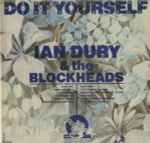
The Blockheads are an English rock band formed in London in 1977. Originally fronted by lead singer Ian Dury as Ian Dury and the Blockheads or Ian and the Blockheads, the band has continued to perform since Dury's death in 2000. As of March 2023[update] members included Chaz Jankel (guitar and keyboards), Nathan King (bass), Mick Gallagher (keyboards and piano), John Turnbull (vocals and guitar), John Roberts (drums), and Mike Bennett (lead vocals). There is a rolling line-up of saxophonists that includes Gilad Atzmon, Terry Edwards, Dave Lewis, and from time to time, the original sax player, Davey Payne. Between 2000 and 2022, the band's lead vocalist and main lyricist was Derek Hussey. The band may be best known for their hit singles (recorded with Dury), "What a Waste", "Hit Me with Your Rhythm Stick", "Reasons to Be Cheerful, Part 3", and "Sex & Drugs & Rock & Roll". In 1974, Radio Caroline's Ronan O'Rahilly set up a pop group, the Loving Awareness Band, comprising John Turnbull (guitar) and Mick Gallagher (keyboards; both formerly of 1960s psychedelic rock band Skip Bifferty), along with the session musicians Norman Watt-Roy (bass) and Charley Charles (drums; born Hugh Glenn Mortimer Charles, Guyana, 1945). In 1976, the Loving Awareness Band released their only album, Loving Awareness (ML001), on O'Rahilly's label More Love Records. The album has appeared on CD more than once, although these reissues have been sourced from a mint vinyl pressing rather than from the original master tapes. The Loving Awareness Band broke up in 1977, and Watt-Roy and Charles joined a new band being formed by Ian Dury, who had begun writing songs with pianist and guitarist Chaz Jankel (the brother of noted music video, TV, commercial and film director Annabel Jankel). With Jankel fashioning Dury's lyrics into number of songs, the two began recording with Charles, Watt-Roy, Gallagher, Turnbull and former Kilburn and the High Roads saxophonist Davey Payne. An album was recorded, but was of no interest to major record labels. Next door to Dury's manager's office, however, was the newly formed Stiff Records, a perfect home for Dury's maverick style. The band was invited by Stiff to join the "Live Stiffs Tour", and the band Ian Dury and the Blockheads was born, with the name ostensibly taken from the song of the same name which portrayed a drunken Essex stereotype: They've got womanly breasts under pale mauve vests Shoes like dead pigs' noses Cornflake packet jacket, catalogue trousers A mouth what never closes - from "Blockheads" (1977) The tour, which also featured Elvis Costello and the Attractions, Nick Lowe, Wreckless Eric and Larry Wallis, was a great success, and Stiff launched a concerted Ian Dury marketing campaign. Under the management of Andrew King and Peter Jenner (the original managers of Pink Floyd) Ian Dury and the Blockheads quickly gained a reputation as one of the top live new wave music acts. Their first single, "Sex & Drugs & Rock & Roll", marked Dury's Stiff debut and although it was banned by the BBC it was named Single of the Week by NME on its release. It was soon followed by the album New Boots and Panties!!, which was eventually to achieve platinum status. (Although it has been claimed that Dury coined the phrase "Sex & Drugs & Rock & Roll", there is evidence that it was already in common use and a very similar phrase had been used by Australian band Daddy Cool for the title of their 1972 second album Sex, Dope & Rock'n'Roll: Teenage Heaven.) A parallel precursor is the longstanding and widely used phrase, wine, women and song. The tune is based on part of Charlie Haden's bass solo on "Ramblin'" on Ornette Coleman's 1959 album Change of the Century. Dury and the band built up a dedicated following in the UK and other countries and scored several hit singles, including "What a Waste", "Hit Me with Your Rhythm Stick" (which was a UK number one at the beginning of 1979, selling just short of a million copies) and "Reasons to Be Cheerful, Part 3" (number three in the UK in 1979). The band's second album, Do It Yourself, was released in June 1979 in a Barney Bubbles-designed sleeve of which there were over a dozen variations, all based on samples from the Crown wallpaper catalogue. Bubbles also designed the Blockhead logo, which received international acclaim and which continues to be used by the band as, for example, on their Live in Colchester 2004 DVD. The hit single "Hit Me With Your Rhythm Stick" was notably not included, however, on the original release of the album. The single and its accompanying music video featured a Davey Payne sax solo with dual saxophones, in evident homage to jazz saxophonist Rahsaan Roland Kirk, who had made this his trademark technique. The Blockheads' sound drew from its members' diverse musical influences, which included jazz, rock and roll, funk, and reggae, and Dury's love of music hall. Jankel left the band temporarily and relocated to the U.S. after the release of "What A Waste" but he subsequently returned to the UK and began touring sporadically with the Blockheads, eventually returning to the group full-time for the recording of "Hit Me With Your Rhythm Stick"; according to Mick Gallagher, the band recorded 28 takes of the song but eventually settled on the second take for the single release. Partly due to personality clashes with Dury, Jankel quit the group again in 1980, after the recording of the Do It Yourself LP, and he returned to the U.S. to concentrate on his solo career. The group worked solidly over the 18 months between the release of "Rhythm Stick" and their next single, "Reasons to Be Cheerful", which returned them to the charts, making the UK Top 10. Jankel was replaced by former Dr. Feelgood guitarist Wilko Johnson, who also contributed to the next album Laughter and its two minor hit singles, although Gallagher recalls that the recording of the Laughter album was difficult and that Dury was drinking heavily in this period. In 1980-81, Dury and Jankel teamed up again with Sly and Robbie and the Compass Point All Stars to record Lord Upminster. The Blockheads toured the U.K. and Europe throughout 1981, sometimes augmented by Don Cherry on trumpet, ending the year with their only tour of Australia. The Blockheads disbanded in early 1982 after Dury secured a new recording deal with Polydor Records through A&R man Frank Neilson. Choosing to work with a new group of young musicians which he named The Music Students, he recorded the album Four Thousand Weeks' Holiday. This album marked a departure from his usual style and was not as well received by existing fans for its dance music influence.[citation needed] The Blockheads briefly reformed in June 1987 to play a short tour of Japan and then disbanded again. In September 1990, following the death from colorectal cancer of drummer Charley Charles, they reunited for two benefit concerts in aid of Charles' family, held at The Forum, Kentish Town, with Steven Monti on drums. In December 1990, augmented by Merlin Rhys-Jones on guitar and Will Parnell on percussion, they recorded the live album Warts & Audience at the Brixton Academy. The Blockheads (without Jankel, who returned to California) toured Spain in January 1991, then disbanded again until August 1994 when, following Jankel's return to England, they were invited to reform for the Madstock Festival in Finsbury Park; this was followed by sporadic gigs in Europe, Ireland, the UK and Japan through late 1994 and 1995. In the early 1990s, Dury appeared with English band Curve on the benefit compilation album Peace Together. Dury and Curve singer Toni Halliday shared vocals on a cover of the Blockheads' track "What a Waste". In March 1996, Dury was diagnosed with cancer. After his recovery from surgery, he set about writing another album. In late 1996 he reunited with the Blockheads to record the well-received Mr. Love Pants. Ian Dury and the Blockheads toured again, with Dylan Howe replacing
Discografía en vinilo
Ordenada por relevancia (lo más escuchado primero).


En la onda de Ian Dury & the Blockheads
Otros artistas afines, con vinilo.