Eric Salzman
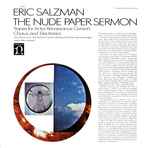
Eric Salzman (September 8, 1933 – November 12, 2017) was an American composer, scholar, author, impresario, music critic, and record producer. He is best known for his contributions to 'New Music Theater,' a concept he advanced through both his compositions and writings. He established it as an independent art form, distinct from grand opera and popular musicals, both aesthetically and economically. He co-founded the American Music Theater Festival and was, at the time of his death in 2017, Composer-in-Residence at the Center for Contemporary Opera. Salzman's one true opera, Big Jim and the Small-Time Investors (written and revised between 1985 and 2017), was developed in workshops at CCO in 2010 and 2014. It received its world-premiere production at Symphony Space in 2018, five months after his death, praised by Opera News as "truly a fine piece of post-modern creative work." Performers of his works include the New York Philharmonic, BBC Symphony Orchestra, Minnesota Orchestra, Brooklyn Philharmonic; conductors Pierre Boulez, Stanisław Skrowaczewski, Dennis Russell Davies and Lukas Foss; ensembles Western Wind and Kronos Quartet; soloists Philip Langridge, Mary Thomas, Elise Ross, Stanley Silverman, Alan Titus, Rinde Eckert, Igor Kipnis, Paul Zukofsky, Theo Bleckmann, Thomas Young; actors Stacy Keach, John O'Hurley and Paul Hecht. Salzman was born September 8, 1933, in New York City and attended Forest Hills High School (1946–1950). After studying composition privately (1949–51) with Morris Lawner, who taught at the New York High School of Music and Art, he continued his studies at Columbia University (1954 Bachelor of Arts), majoring in music and minoring in literature. At Columbia, his teachers included Jack Beeson, Lionel Trilling, Otto Luening, and Vladimir Ussachevsky. He pursued postgraduate work at Princeton University (1956 master of fine arts) with Milton Babbitt, Roger Sessions, Earl Kim, Edward T. Cone, Arthur Mendel, Oliver Strunk, and Nino Pirrotta. A Fulbright Fellowship (1956 – 58) enabled him to study at the Accademia di Santa Cecilia in Rome with Goffredo Petrassi and at the Darmstädter Ferienkurse in Darmstadt with Karlheinz Stockhausen, Bruno Maderna, and Luigi Nono. In 1958, he returned to the United States and began a career as a music critic, writing for The New York Times (1958–62), the New York Herald Tribune (1962–66), and Stereo Review (from 1966 until 1998 when it became Sound and Vision). While at the Herald Tribune in 1964 Salzman was awarded a Ford Foundation Fellowship to cover concerts in Europe. During the Fellowship (1964–65), Salzman was based in Paris. He won the Elsie O. and Philip D. Sang Prize for Critics of the Fine Arts in 1969, an award previously given to Harold Clurman and subsequently to Hilton Kramer. The judges were Aaron Copland, Vladimir Ussachevsky, and Stanisław Skrowaczewski, who cited his writing for Stereo Review. He also worked as contributing editor and critic for Opera News, Opera, Neue Zeitschrift der Musik, New York Magazine, and other publications in Germany, France, and England. Salzman founded and ran The Electric Ear at the Electric Circus from 1967 until 1968. He served as music director of WBAI-FM (Pacifica Radio) from 1962 until 1964, and again from 1968 until 1972, winning a Major Armstrong Award for broadcasting. He interviewed numerous artists, including Stefan Wolpe and Edgard Varèse, and was himself interviewed by Virgil Thomson as the special guest on Thomson's radio program for WNCN-FM in 1970. Through his work at WBAI, where he founded the Free Music Store, Salzman was approached by Joseph Papp in 1968 to create concerts for the then-vacant Martinson Hall at The Public Theater. As a result, the Free Music Store presented free concerts in Martinson Hall until Papp evicted the group in 1971. The Free Music Store provided a platform for musicians who wanted to explore new musical projects while foregoing compensation. Among many programs, the Free Music Store organized formal performances of ragtime music, presenting concerts featuring Eubie Blake and others. Salzman left the Free Music Store in 1972, though the Free Music Store continued operating in various locations under the leadership of Ira Weitzman. From 1975 to 1990, Salzman produced and directed over two dozen recordings, mainly for Nonesuch Records, including two Grammy Award-nominated records: the Hal Prince production of Kurt Weill's The Silver Lake with the New York City Opera conducted by Julius Rudel (1980) and The Unknown Kurt Weill, featuring Teresa Stratas (1991). He produced the Nonesuch album The Tango Project (1991) and the two follow-up Tango Project albums, Two to Tango and The Palm Court. The first Tango Project album, for which Salzman and his collaborators transcribed Carlos Gardel's Por una Cabeza, won a Stereo Review Award for Record of the Year and was featured prominently in the films Scent of a Woman (1992) and True Lies (1994). The album has been credited for bringing attention to tango music both in Argentina and internationally. Salzman also produced several recordings featuring the music of Harry Partch and William Bolcom, as well as his own music. According to Salzman's writing, the future of opera and musical theater lies in economically viable, small-scale theater where music is the dominant driving force. This concept is evident in Salzman's early works, such as: Verses and Cantos (1967) The Peloponnesian War, full-evening mime/dance/theater piece with dancer/choreographer Daniel Nagrin (1967 tour) Feedback, multimedia participatory environmental work for live performers, visuals, tape with Stan Vanderbeek (1968; 1969 Torcuato di Tella Institute with Marta Minujín; New York Public Television 1969) Nude Paper Sermon, for actor (played by Stacy Keach) Renaissance consort, chorus, electronics (commissioned by Nonesuch in 1969) toured widely in a theatrical version The Nonesuch recording of Nude Paper Sermon was chosen separately by both Dennis Báthory-Kitsz and David Gunn, creators and hosts of the Kalvos & Damian New Music Bazaar, for their "Top 100" desert island recordings. In 1967, Salzman founded the "New Image of Sound" series at Hunter College, where his theatrical composition Verses and Cantos (or Foxes and Hedgehogs) was performed for the inaugural concert conducted by Dennis Russell Davies alongside the New York premiere of Berio's Laborintus II. In 1972, Pierre Boulez conducted the piece with the BBC Symphony Orchestra. In 1970, Salzman founded the Quog Music Theater, a mixed-media performing group, which included accordionist William Schimmel and percussionist David Van Tieghem. The ensemble performed many of Salzman's works, including Ecolog, a music theater piece for television (premiered on Channel 13), which received its live premiere at the New York Philharmonic's "Prospective Encounters" series in 1972, as conducted by Boulez. With Quog, Salzman experimented with theatrical forms and ensembles, creating an a capella radio opera and the music drama Lazarus (1973), combining contemporary and medieval elements, which appeared at La MaMa Experimental Theatre Club in 1974 before touring in Europe. Salzman created numerous theatrical works with the musician Michael Sahl, with both artists generally serving as co-composer and co-librettist. Among their many collaborations were The Conjurer (1975) which premiered at the Public Theater under the direction of Tom O'Horgan, and Civilization and Its Discontents, a music theater comedy which premiered at the American Musical and Dramatic Academy in 1977. Civilization and Its Discontents toured Europe extensively, was recorded for National Public Radio and Nonesuch records, and won the Prix Italia and a Backstage Award. Other Sahl/Salzman collaborations were produced in partnership with the Pratt Institute, Victory Theater, WNYC, Theater for the New City, KCRW (Santa Monica), Quog Music Theater, and the American Music Theater Festival.
Discografía en vinilo
Ordenada por relevancia (lo más escuchado primero).
En la onda de Eric Salzman
Otros artistas afines, con vinilo.