Paul Weston
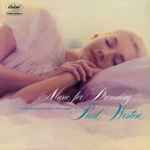
Paul Weston (né Wetstein; March 12, 1912 – September 20, 1996) was an American pianist, arranger, composer, and conductor who worked in music and television from the 1930s to the 1970s, pioneering mood music[broken anchor] and becoming known as "the Father of Mood Music". His compositions include popular music songs such as "I Should Care", "Day by Day", and "Shrimp Boats". He also wrote classical pieces, including "Crescent City Suite" and religious music, authoring several hymns and masses. Born in Springfield, Massachusetts, Weston had a keen interest in music from an early age and learned to play the piano. He was educated at Springfield High School, then attended Dartmouth College and Columbia University. At Dartmouth, Weston formed his own band and toured with the college band. He joined Columbia's dance band, The Blue Lions, but was temporarily unable to perform following a rail accident, and did some arrangements while he recovered. He sold his first arrangements to Joe Haymes in 1934. When Haymes requested more material, Weston's music was heard by Rudy Vallée, who offered him work on his radio show. Weston met Tommy Dorsey through Haymes and in 1936 became a member of Dorsey's orchestra. He persuaded Dorsey to hire The Pied Pipers after hearing them in 1938, and the group toured with the bandleader. After leaving Dorsey in 1940, Weston worked with Dinah Shore and moved to Hollywood when he was offered film work. In California he met Johnny Mercer, who invited him to write for his new label, Capitol Records. Weston became music director there, where he worked with singer Jo Stafford and developed the mood music genre. Stafford moved with him to Columbia Records in 1950, and they were married in 1952. Weston worked extensively in television from the 1950s to the 1970s. He helped start the Grammy Awards, which were first presented in 1959. He was honored with a Grammy Trustees Award in 1971 and spent three years as music director of Disney on Parade. Weston and Stafford developed a comedy routine where they assumed the guise of a bad lounge act named Jonathan and Darlene Edwards. Their first album was released in 1957. In 1960, their album Jonathan and Darlene Edwards in Paris won the Grammy Award for Best Comedy Album. Weston's work in music is honored with a star on the Hollywood Walk of Fame. Weston was born Paul Wetstein in Springfield, Massachusetts, to Paul Wetstein, a teacher, and Anna "Annie" Grady. The family moved to Pittsfield when Weston was two, and he spent his formative years in the town. His parents were both interested in music, and when Paul Sr taught at a private girls' school, he was allowed to bring the school's gramophone home over the Christmas holidays. Weston remembered hearing "Whispering Hope" on it as a child. At age eight, he started piano lessons. He was an economics major at Dartmouth College in New Hampshire, where he graduated cum laude and Phi Beta Kappa in 1933. During his college days, Weston had his own band called "the Green Serenaders"; this allowed him to pay his own college tuition. Weston also learned how to play the clarinet so he could travel with the college band. He went to graduate school at Columbia University and was active in the Blue Lions, Columbia's dance band. In January 1934, Weston was seriously injured in a train accident. While trying to catch a train, Weston grabbed a door handle as the train sped off. He was able to hold on to the handle and was dragged two and one half miles before losing his grip. Unable to be active in a band, he started doing music arranging as a way to keep some involvement with music while convalescing. When he returned to New York in the fall of 1934, he made his first sale of his work to Joe Haymes. Haymes liked Weston's work enough to ask him to do more arrangements for his band. His medley of Anything Goes songs was heard by Rudy Vallée, who contacted him and offered Weston a job as an arranger for his Fleischmann's Hour on radio. Weston was also doing arranging for Phil Harris. He met Tommy Dorsey through his work with Joe Haymes. Following the Dorsey Brothers split in 1935, Tommy had yet to form an orchestra; he used the Joe Haymes Orchestra for his first engagement as a solo conductor. Weston joined Dorsey as chief arranger in 1936, holding the position until 1940. He became Dinah Shore's arranger/conductor and worked freelance for the Bob Crosby Orchestra. Weston also worked with Fibber McGee and Molly and Paul Whiteman. When Bob Crosby's band was hired for his brother Bing's film, Holiday Inn, this took him to Hollywood and into film work. He changed his name from Wetstein to Weston after his arrival in California. Weston was asked to do more work for Bing Crosby and Bob Hope, and also for Betty Hutton. Subsequent films as musical director include Belle of the Yukon (1944) and Road To Utopia (1945). Weston met Johnny Mercer while working for Paramount in 1942; Mercer, who was preparing to start Capitol Records, wanted Weston to write for his new company. Paul wrote, arranged and directed Mercer's "Strip Polka"—the first arrangement written for the new label on April 6, 1942. On August first of that year, the 1942–44 musicians' strike began. No union musicians could record for any record company, but were able to play for live engagements and radio shows; the issue which prompted the strike was regarding record companies paying royalties to musicians. Many record companies had "stockpiled" recordings of their stars prior to the strike, planning to release them over a period of time. While the older, more established record labels were able to do this, the newly formed Capitol had no opportunity to do likewise. The strike brought the new company to a standstill until Johnny Mercer began his radio show, Johnny Mercer's Music Shop, in June 1943. The radio show was meant to be a venue for Capitol's talent during the Musicians' Strike. Mercer and Capitol recording artist Jo Stafford hosted the program, with Weston and his orchestra providing the music for it. Stafford and Weston had first met in 1938, when he was working as an arranger for Tommy Dorsey; Weston was responsible for getting Stafford's group, the Pied Pipers, an audition with Dorsey for his radio show. The recording ban was lifted for Capitol in October 1943 after an agreement was reached between the Musicians' Union and the record company; Weston was then able to return to the recording studio. In 1944, he became the company's music director. When appointed, Weston was the youngest musical director for any major record company. Besides his work at Capitol, Weston did conducting for many radio shows during this time. He worked with Duffy's Tavern, the radio shows of Joan Davis, and Your Hit Parade. Jo Stafford, who became a regular host of the Chesterfield Supper Club in 1945, returned to California permanently in November 1946. Stafford later hosted the show from Hollywood, with Weston and his orchestra. It was around this time that Weston had a new idea for recorded music that would be similar to the soundtrack of a movie. It could be an enhancement to living but subtle enough not to stifle conversation. His album Music For Dreaming was the beginning of the "Mood Music" genre. In 1950, he left Capitol for a similar position at Columbia Records; Jo Stafford also signed with Columbia at the same time. He remained active in radio, with his own The Paul Weston Show, and also in acting roles on Dear John with Irene Rich, Valiant Lady, and Cavalcade of America. In mid-1949, Capitol Records issued a promotional ten-inch vinylite record for disk jockeys only, entitled What Is This Thing Called Bop?. Containing orchestration from Weston's orchestra, the disc is a lecture narrated by Tom Reddy, tracing the history of jazz from the era of Lead Belly through various other jazz genres, such as swing, before arriving at bebop, accompanied throughout by musical examples. It was shipped to every major DJ in
Discografía en vinilo
Ordenada por relevancia (lo más escuchado primero).




En la onda de Paul Weston
Otros artistas afines, con vinilo.